Samar ApsaraINFRATECH
  1. Home
  2. Piling & Deep Foundations

Pillar A Deep foundations & piling

Loads above.Engineering below.

Bored and micro piles that carry structural load into suitable ground — engineered systems, not just holes. For buildings, industrial structures, infrastructure, bridges and heavy structures, and difficult ground.
  • Buildings
  • Industrial structures
  • Infrastructure
  • Bridges & heavy structures
  • Difficult ground
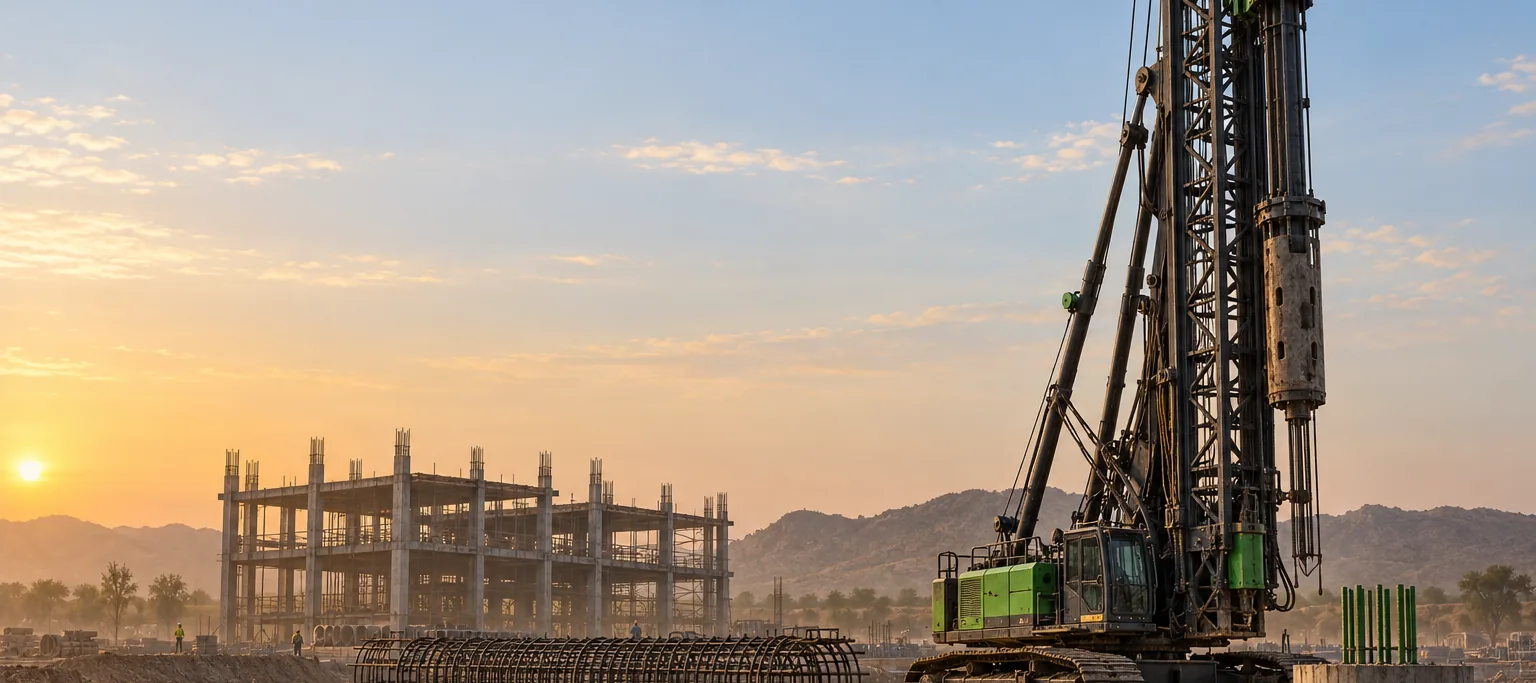
Bored-piling site at sunrise: a green crawler-mounted rotary piling rig beside a reinforcement cage on timber bearers, a cast pile cap with green starter bars and a concrete building frame.
STRUCTUREPILE CAPØ 200 –2000 mmREINFORCEDPILE SHAFTFOUNDINGSTRATASTRUCTURALLOAD

Load path Scroll to follow the load

From structure
to ground.

Load Stage

Structural load

Dead, live and equipment loads gather at each column. The foundation has to carry them without unacceptable settlement.

  • Dead load
  • Live load
  • Equipment

The pile cap

The cap ties the pile group together and spreads every column load across the piles beneath it.

  • Load spreading
  • Pile group
  • Column dowels

Shaft & reinforcement

A bored pile is a reinforced-concrete column cast in the ground: a cage of vertical bars and rings inside a concrete shaft. Diameter and length come from the design.

  • Reinforcement cage
  • Concrete shaft
  • Ø 200 – 2000 mm

Skin resistance

Along the shaft, friction between concrete and soil carries part of the load. Each soil layer contributes differently.

  • Shaft friction
  • Layer by layer
  • Load transfer

End bearing

At the toe, the pile bears on competent strata — or is socketed into rock where the design calls for it.

  • Founding strata
  • Rock socket
  • End bearing

The foundation system

Structure, cap, shaft, soil and rock work as one path. Each stage is drilled, reinforced and cast to specification.

  • Structure → cap
  • Shaft → ground
  • One load path

Illustrative load path. Pile design, capacity and testing are set by the project's structural and geotechnical engineer; Samar executes to that design.

FILL · TOPSOILLOOSE SAND · SILTSTIFF CLAY · KANKARROCK · FOUNDING STRATASTRUCTURESTRUCTURAL LOADPILE CAPØ 200 –2000 mmPILE LENGTH · LREINFORCEDSHAFTSKINRESISTANCEEND BEARINGSTRATUMSTRUCTUREPILE CAPPILE SHAFTSOIL / ROCKSUPPORT

Scale Pile diameter, drawn to scale

200 to 2000.
See the difference.

Five cross-sections on one scale — from a 200 mm micro pile to a 2000 mm bored pile. The reinforcement cage grows with the shaft.

Ø 200Micro piles
Ø 450Light structures
Ø 750Buildings
Ø 1200Heavy structures
Ø 2000Largest bored piles

Plan view · true relative scaleCage illustrative

Ø2000Ø1200Ø750Ø450Ø200

Overlaid on one scaleØ in mm

Methods Five ways to go deep

The method follows
the ground.

Select a method. Ground, access and load decide which one is right — we confirm against soil data before drilling.

Documented in work orders

Micro / DTH / ODEX

Compact drilling for restricted sites. ODEX advances casing together with the bit through boulders and collapsing ground; a DTH hammer drives through rock.

Suited to

  • Boulders, cobbles and mixed fill
  • Rock and weathered rock
  • Restricted access and headroom

Process

  • Compact rigs
  • Casing advanced with the bit (ODEX)
  • Air-hammer penetration in rock (DTH)
Diameter · indicative
200 mm2000 mm

Small diameter · Underpinning · retrofits · tight urban plots

Capability

Auger Piling

A rotating auger bores and lifts spoil on its flights. Fast, clean cycles wherever the soil will stand open without support.

Suited to

  • Cohesive and stiff soils
  • Above the water table
  • Open, accessible sites

Process

  • Continuous rotation
  • Spoil lifted on the flights
  • No drilling fluid needed
Diameter · indicative
200 mm2000 mm

Small to medium · Housing · low-rise · boundary and retaining piles

Capability

DMC · Mud Circulation

Drilling fluid is pumped down the drill string and returns carrying cuttings, holding the bore wall where the ground will not stand open.

Suited to

  • Loose and collapsing sands
  • Below the water table
  • Deep, unstable profiles

Process

  • Fluid pumped through the drill string
  • Cuttings carried to a settling pit
  • Bore wall held by fluid pressure
Diameter · indicative
200 mm2000 mm

Medium to large · Deep bored piles in unstable ground

Capability

Rotary Piling

A rotary head on a heavy drill string, fitted with tools chosen for the formation - the workhorse for large diameters and hard strata.

Suited to

  • Mixed strata to hard rock
  • Deep founding levels
  • Large diameters

Process

  • Heavy drill string and rotary head
  • Tooling changed to suit the formation
  • Rock socketing where designed
Diameter · indicative
200 mm2000 mm

Large diameter · Heavy structures · bridges · industrial plant

Capability

Hydraulic Method Piling

Hydraulic power rotates and presses casing ahead of the bore, keeping it supported and vertical in variable or water-bearing ground.

Suited to

  • Variable and water-bearing ground
  • Sensitive neighbouring structures
  • Tight verticality tolerances

Process

  • Casing-supported bore
  • Controlled force and verticality
  • Lower disturbance to surroundings
Diameter · indicative
200 mm2000 mm

Medium to large · Sensitive sites · variable ground

Anatomy Inside a bored pile

Steel and concrete,
working as one.

FOUNDING STRATUMCAGE · EXPLODEDBACDEFG

Execution One pile, seven stages

From point
to finished pile.

  1. 01

    Mobilise

    Rig, casing and materials to site; access and safety set up.

  2. 02

    Position

    Rig set over the surveyed pile point and the mast plumbed.

  3. 03

    Drill

    Bore advanced by the method the ground demands.

  4. 04

    Stabilise

    Temporary casing or drilling fluid holds the bore open.

  5. 05

    Cage

    Reinforcement cage lowered to the design level.

  6. 06

    Concrete

    Concrete placed by tremie from the base upward.

  7. 07

    Test / hand over

    Checks per specification; records handed over.

Stabilise adapts to the method: temporary casing for ODEX and hydraulic-method piling, drilling fluid for DMC, none where the soil stands open (auger). Test scope follows the project specification.

Plant Foundation machinery
Rigs, cages
and support.

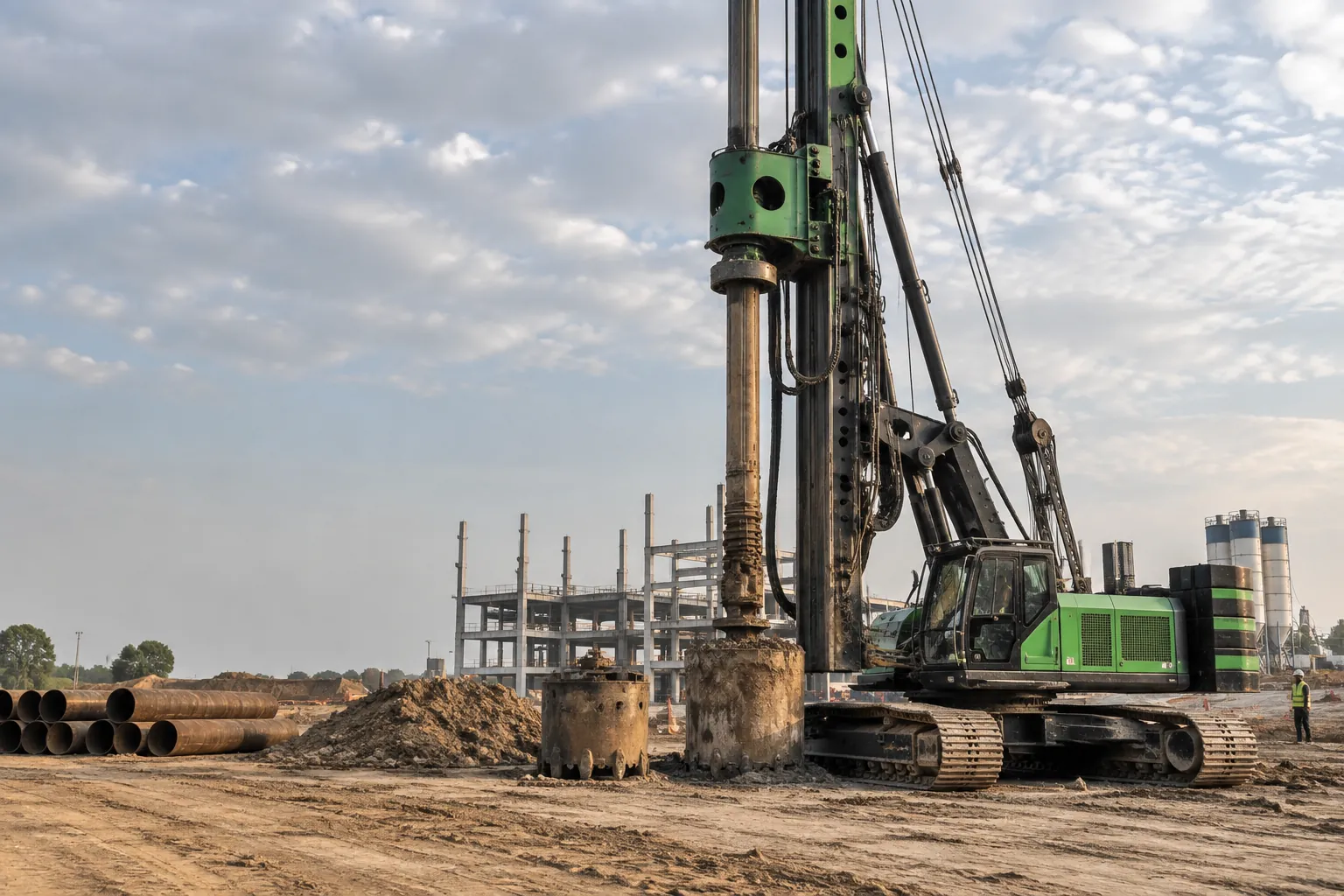
Crawler-mounted rotary piling rig with its mast raised, a drilling bucket and stacked steel casing on a levelled site platform.
Piling rig · rotary foundation rigRotary drive on a heavy mast — the primary plant for large-diameter bored piles and rock socketing.Large diameter · deep founding
Auger set-upContinuous-flight auger for stable, cohesive soils.Auger piling
DMC set-upMud pit, pump and return channel around the rig.Direct mud circulation
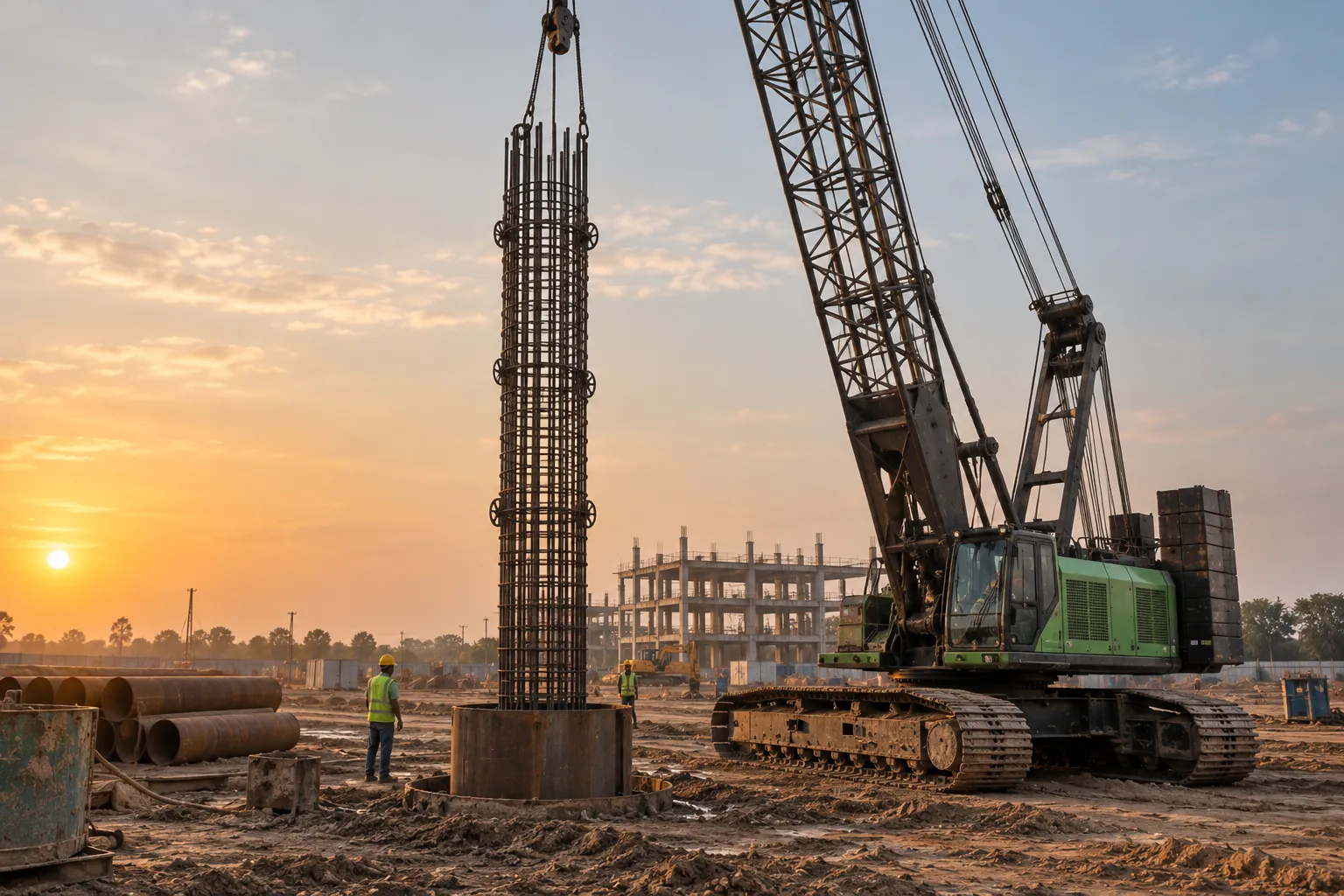
A crawler crane lowering a long reinforcement cage into a cased bore at sunrise.
Cage handling & loweringReinforcement cages lifted and lowered into the bore.Reinforcement
ODEX / DTH rigCasing-advance and air-hammer drilling for micro and small-diameter piles.Micro · DTH · ODEX
Support worksCage shop & fabricationReinforcement cages, casing and liner, steel work.Infrastructure & fabrication →
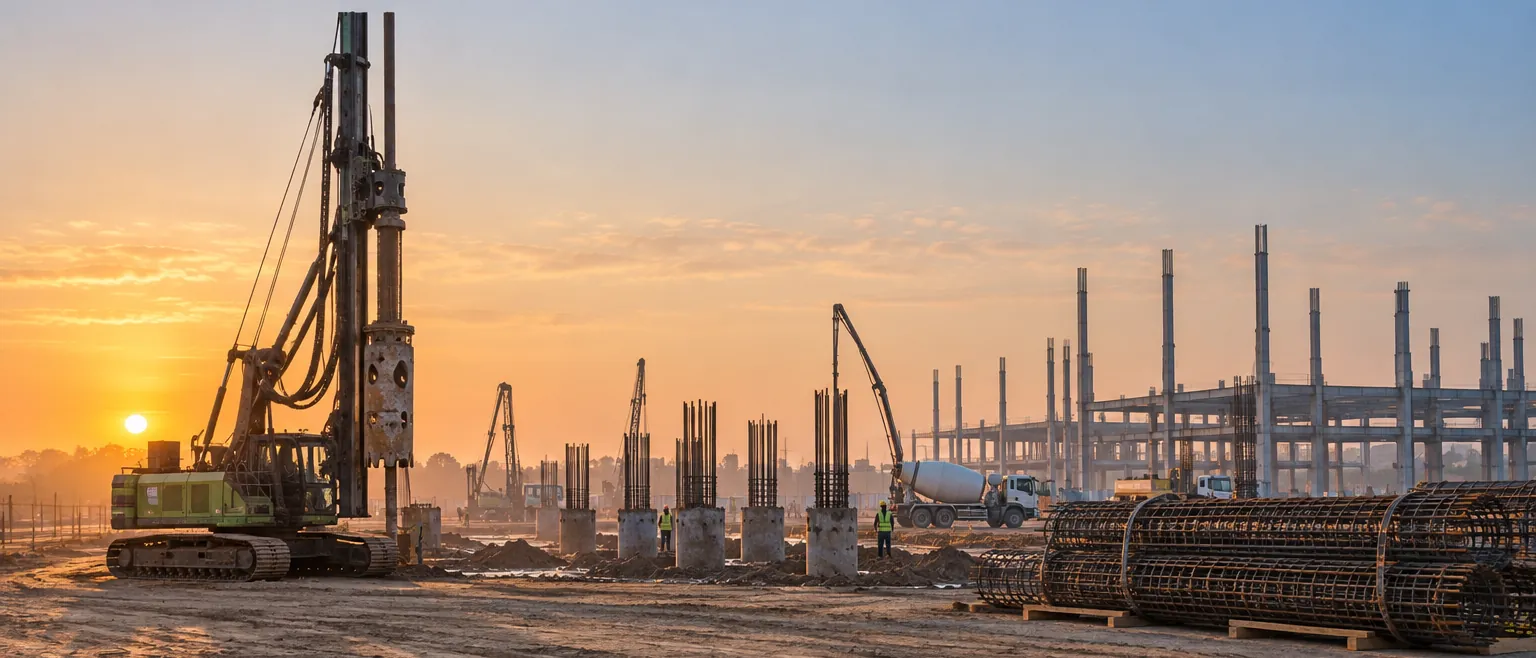
Wide dawn view of a foundation site: a rotary piling rig at left, completed piles with projecting starter bars, stacked reinforcement cages, a concrete mixer and a concrete-framed building.
GL ±0.00Foundation site · illustrative image

Applications What the foundation must do

Where deep
foundations earn it.

Industrial plants

Heavy equipment, tanks and process structures on filled or mixed ground, where settlement control matters.

Methods usually considered

Multi-storey & commercial buildings

Concentrated column loads, basements and close neighbouring structures.

Methods usually considered

Bridges & heavy civil works

Large diameters, high axial and lateral loads, river and water-bearing ground.

Methods usually considered

Infrastructure

Viaduct and flyover piers, abutments and retaining works along linear corridors.

Methods usually considered

Tanks & utility structures

Elevated tanks, treatment units and utility structures with heavy, concentrated loads.

Methods usually considered

Weak & difficult ground

Fill, loose sand, boulders and high water tables where shallow foundations are unsafe.

Methods usually considered

Method selection is confirmed against soil investigation data and the structural design.

Enquiry BOQ · RFQ · Site requirement

Planning your next foundation or groundwater project?

Send the BOQ, drawings or a few lines on the site. We respond directly.

Upload / Share BOQ on WhatsApp

Share your requirement

This opens WhatsApp or your email app with your details pre-filled — nothing is stored on this website.